Friday, 26 April 2013

London

Courtesy of the Arts Council, I've been able to come up to London and see what I can find in the many archives, museums and galleries here. I've been looking for anything that will inspire presentation and help me to get into the spirit and aesthetic of the period.


Here are some highlights:


The Museum of Childhood in Bethnal Green had magic lanterns, a popular entertainment when Isabella was a girl. There was no TV and films were only in embryonic form by the time she was a teenager. There were no laptops or computer games, and for a girl, no Facebook, only posting letters and wiring telegrams. No plastic, so toys and games would have been made of wood, card, paper or metal.

In Tate Britain there was a 1900 portrait of a young Edwardian lady by Sir William Orpen.


It helps me, because it is hard to work out what colours clothes and rooms would have been from black and white photos.

The contrast with his war painting of 1918 shows something of the change people would have had to cope with.


From 1914, Edward Reginald Frampton painted the anguish of a young French couple as the young man went off to war:


A visit to the Army Medical Services Museum in Keogh Barracks gave me a lot of information about the way the army has cared for the wounded over the centuries. I hadn't realised such care had a very long history.

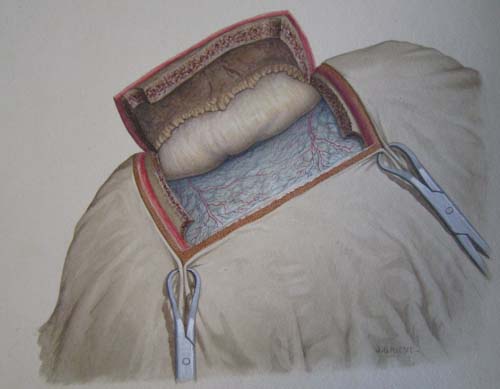
The Hunterian Museum had some powerful images of war wounds, as well as Joseph Lister's dissecting kit, which was almost identical to Isabella's. The Foundling Museum told poignant stories of children whom their mothers had had to abandon.


In the Wellcome Collection there was a magnificently gruesome installation about the potential use of insects as food.


I was unexpectedly moved by the Souzou exhibtion of Japanese Outsider Art


Satoshi Murita's embroidery on a blanket took my eye and reminded me of the sheer physicality of the sickness Isabella would have had to face. Blankets, sheets, bandages, smells, disinfectants, pus......


In their Medicine Now exhibition, a range of artists had created installations that explored different aspects of modern medicine. 

Cultural DNA


The difference between these artistically directed pieces and the historical and precisely accurate displays in the previous museums I'd visited was palpable. Each have their place, and that is one of the choices I will need to make in relating Isabella's story.

One artist had had a necklace created from the sequencing of his DNA. That linked in well with two of the concepts at the back of my mind in doing this project - legacy, and beads. 

What consequences did Isabella's actions have for future generations? The knowledge that geneticists call a particular electron-microscopic view of DNA 'beads on a string' still haunts me. In the broader sense, what legacy did the deeds of feisty women of Isabella's generation leave for us, how did they change our conceptual DNA and inculcate the thinking of our culture? Was it all beneficial?


Monday, 22 April 2013

Edinburgh


Isabella came from Edinburgh, so I wanted to find Scots who'd be interested in the tale, and I needed to collect photos of the places where she had been. The Arts Council Grant enabled me visit the city.


Fiona Herbert  is a Scottish Storyteller, experienced in telling stories of all sorts - traditional tales, historic stories and even fictions fresh off the keyboards of her creative writing classes. When she heard Isabella's story, she agreed to help me. I'm going to need Scottish voices.


Isabella loved gardens, so she is likely to have seen this beech hedge in the Royal Botanic gardens, which is over a century old, but how big would it have been then? The archive of the RBG has boxes and boxes of old photos and gave some unexpected insights into what she would have seen.


I said in my last post that stitching is part of my plan of how to tell Isabella's story, and I met up with Mairi Brown,who runs sewing classes as well as making the most amazing corsets and more. 


Someone who can shape a garment and decorate it so skilfully as well as running stitching classes in Edinburgh would be a great help Thankfully, Mairi agreed to be that person.


Next, I met Catriona Reynolds and recorded the story of her Great-Aunt, Norah Neilson Gray, who painted this picture of the wounded at Royaumont, a hospital run by the Scottish Women's Hospital Movement.


Following Alyson Fielding's recommendation, I met Peggy Hughes and Claire Stewart from Electric Bookshop.


They proved to have massive expertise in the world of books, literature, literacy and poetry as well as their concern with the potential digital future of stories and sparked a power house of ideas.


Sally Booth used painting and poems to tell the stories of Shetland islanders to the Scottish Parliament building. A completely different mode of storytelling, and a real treat to see inside the building.


Lothian Health Services Archive provided useful images, the National Library of Scotland useful books, the Central Library useful printing facilities and other anonymous supporters made it a very productive week.


Tuesday, 9 April 2013

Detective story


I have spent over 2 years uncovering the story of Isabella, a young Edinburgh woman who served as a doctor during the First World War. I have made many failed attempts to write it down in book format, but at last these few weeks of Arts Council of Wales sponsorship have inspired a way forward, and, despite my indecisive and prevaricating nature, I’ve come up with a way of telling Isabella’s story that I think will work, and I hope will be fun for people to explore.


I set myself some parameters: 


It had to connect with ordinary people, not just gallery going artists, people like the ladies from the over 50s exercise class who grumbled when my show at The Gate in 2005 came down.

It had to be portable, so it could visit a space for a short time - a school, library, community group, gallery, museum. 

It had to involve the voices of real twenty-first century people.


It had to involve stitching. Isabella was brought up to sew a fine seam and ended up stitching men.


It had to allow other people to take part, making it a celebration of womanly achievement, not merely the story of one woman.


It had to convey the sense of excitement that I’ve experienced while doing the research to uncover the story.


As a story, it had to create the opportunity for people to talk, tell their own stories and respond.


So my version of Isabella’s story will be multi-media, including textiles, artist’s books, audio, photography and what might loosely be called film.


To give away any more would spoil the ending, but I’m looking for:


artists who might be interested to chat or collaborate
Scots who might read voiceovers
groups or classes who might like to play a small part
places that might like to show the work


I’ll be in Edinburgh 15-18th April, and London 22nd - 26th. The rest of the time I’m in South Wales. Anyone out there? Get in touch.

Thursday, 4 April 2013

So many stories, so many ways


Did tales begin by the fire, connecting with poetry, rhythm and song? Did people act them out, impersonate the characters with their voices and their beings? Did the listeners quietly listen, or did they heckle, sing along, divert the tale? Did it matter what the story was, and who was telling it?


With painting, and writing, stories could be told without a storyteller; they could be digested on their own. Stories no longer had to be a communal event.


When print came along, stories could travel far and wide. They grew lives of their own, and as literacy grew, more people could interpret the squiggles on the page and recount the tales to themselves and others. And people in different places encountered the same tales and found common ground.

With photography came film, and television, and .... Youtube.....

I'm getting fanciful now.

But since there are so many ways of telling stories, I've been taking advantage of this research grant to meet people who choose different media to tell their stories. Why should one medium work better than another? Are some stories better suited to one medium rather than another? What are the limitations and advantages of different storytelling modes: Live theatre vs film? Book vs film vs oral storytelling? And where do new, digital modes of storytelling fit in, and are there limits to what they can achieve?

But maybe all that comes later - why tell a story in the first place? What do story recipients gain from a story? Different environments produce different responsiveness, effects, results. How does that feed into the decision to tell a story one way or another?

Has the advent of the internet and social media changed the way stories are received? Is the traditional model of a linear narrative less relevant in an age when people have been accustomed to continual commentary through Twitter and other social networking sites? Are there ways of telling stories which allow the story recipient more control, more interaction? How many people want that sort of experience, or will it always be nice and relaxing to sit down with a good book/film and receive a good story?

All stories are not designed for all audiences - who would be interested in Isabella, and how do these changes affect the way her story deserves to be told?


Wednesday, 3 April 2013

Styles of the times

I'm looking into the style of images in the Edwardian period and the War - what ticked people's boxes, what were their skills? What resources did they have to hand?

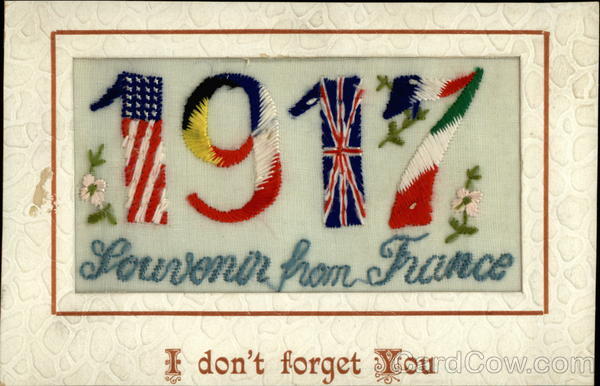
Embroidered postcards during the war mainly featured flowers, flags and medals with the odd animal thrown in for luck.


Occasionally quite funky, symbolic text appears:

Soldiers would not have been able to make these, even with time on their hands waiting in trenches or hospitals.

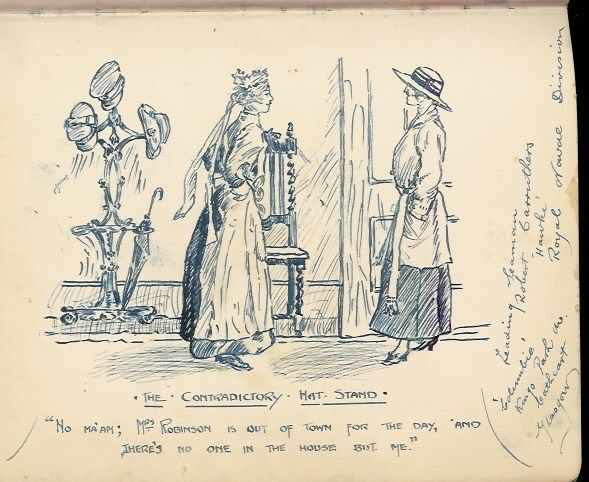
But there's an album online of images scanned from a book kept by one of the women who graduated with Isabella, Celia McNeill. http://s143.photobucket.com/user/quartz-quill/library/WW1?page=1 
It's full of drawings, paintings and poems done by the wounded men she was treating. 


The standard of the painting varies:


as does the literacy level of the men:


But it amazes me that they possessed any of the skills to draw or paint. It challenges my stereotype of men in the war as much as Isabella does with her doctoring.


Friday, 29 March 2013

The problem of the missing papers

I've been pondering Isabella's story for months and have kept coming up against a dilemma - she left no diaries or letters. Her only texts are a few words on the back of a couple of post cards.


If you read it carefully, you'll see that she signs herself 'B', which brings me to another source about her - people who knew her. But very few of those remain. One of them told me off the other day, "You must stop calling her Isabella," she scolded, "She was never called that. It was always Belle or Isabel." To which I had to reply, "That's precisely why I call her that. If I get it wrong it doesn't matter."

It's getting it wrong that I've been afraid of. A good story needs a strong character. Without her own voice from personal papers or people who knew her, I have to invent the dialogue, reactions to events, motivations. It's a question of looking at the documentation I have discovered and saying, "Who do you think she was?" I may have posted about that before - it's a question that has haunted me for the last couple of years.

But a set of facts/choices/actions do not reveal the character of the woman who went through them. Amongst a group of people working in the same job in the same place, there will be diverse motivations, diverse personalities and diverse skills.  I can look at my research and invent all sorts of different scenarios. And I don't want to impose my ideas onto her story. That would be fiction. Let alone that it would be impossible to write dialogue in a Scottish accent.

But hearing Alan Bennett being interviewed on the radio the other day helped.

The interviewer asked him if his parents had liked the way they were portrayed in his work, and followed up by asking him if he liked the way he himself was portrayed when people acted him in the plays he himself had written.

The answer didn't matter, what mattered was that it made me realise that, like with photos, people are quite likely not to like or recognise the way they are portrayed. Each person is so multi-layered and many faceted that a single portrayal cannot encompass the whole. 

Let alone that people are mutable. Their minds and thinking shift and alter, even within short spaces of time. Think about decision making - how hard it can be to work out what to do, let alone why, and how the 'why' can depend on the person we are telling. "Oh, I wouldn't tell her that, but really...." It even alters with how honest or not we are with ourselves. With time, particular versions of stories we tell about our experiences develop, 'truth' becomes fixed, a sort of authorised version. But Isabella told no-one about her experiences; she chose not to make any version public. Susan Sontag is quoted as saying:

‘Beware,’ wrote Susan Sontag in her notebook in 1961, ‘of anything that you hear yourself saying often.’


I doubt if Isabella could ever have been happy with the picture it might have been possible to build up from any papers she had left behind. It makes me ponder the difference between an 'authorised' biographies, and one that is not. I read a biography of Gertrude Bell recently. It was littered with quotes from her letters and diaries. They gave an accurate picture of where she went, and when, but how accurate were the expressions of motivation and the more mutable aspects of a person that build up that indefinable thing, character? Maybe she changed her mind after penning the words. They can only reflect what she felt at the moment the ink trailed onto the page. 

Coming up with an accurate portrayal of a character seems a big task, doomed to failure. To quote some lines from 'The Sound of Music':

How do you catch a cloud and pin it down?
How do you hold a moonbeam in your hand?
How do you keep a wave upon the sand?


I can only tell my version of the story, and recognise that someone else would see it differently, tell it differently. Which is very liberating.


Wednesday, 27 March 2013

Fact, fiction and interpretation

Accuracy has been bugging me a lot with respect to the telling of Isabella's story. How can I link the facts together to tell the story without allowing error to creep in? But sticking solely to the 'facts' results in a turgid list, losing the essence of whatever story there is.


Katherine Angel expressed the dilemma beautifully in an article in Aeon magazine:

I want to understand the past — the past of others, and of myself: what has shaped us, why we feel and think and do the things we do. But I don’t want to fossilise it, to preserve it in aspic. I don’t want to tell a solid, stolid story. And the reason I don’t want to do that is because it’s a way of killing the past, immobilising it: pinning its arms down, and saying, ‘I understand you now. Don’t move. Don’t you dare elude me again.’


But I do want to understand, and to tell a story even if that story is never closed, never complete, never conclusive. The writing of history — whether that of past epochs, people, events, or that of ourselves — has been profoundly challenged in recent decades. Access to the past is woefully indirect and unreliable, goes the argument. The evidence we have is incomplete and our own investments — theoretical, political, personal — shape what we find in it.

That excavatory urge vies in me with something else: a feeling that there is something absurd and impossible about attempting to know — definitively, once and for all, truthfully — about the past, any past, even if that search must always be pursued. There is no control experiment; we have nothing against which to test our speculations. All we have is our own life, our own singularity. And in both realms — in things outside ourselves, and in things within — all we have are hypotheses, some good, and some less so. Which is, I think, perfectly fine.

Simultaneously, I came across two instances of 'facts' which were less than 100% accurate. 

My first find was on a website documenting the CVs of the women who went out to Malta with the army in 1916. Isabella is listed, as she should be.  Stenhouse Isabella

I was excited to discover that she had been awarded the Wellcome Medal, (gold medal), in the History of Medicine at the University of Edinburgh graduation ceremony. I knew she had won one prize. Had she won two?

A spot of internet research and careful sifting through the hundreds of files on my computer told me what had happened. The published list of prize winners was not tabulated, it ran straight from one line to the next. Did the name of the prize come first, or the name of the graduate who had won it? The website creator had read the list one way, and given Isabella a prize for History of Medicine. I read the list the other way, and awarded her the Dorothy Gilfillan Prize for most distinguished woman medical student. Thankfully for my confidence in my research, a second source corroborated my reading of the list rather than the website's interpretation, but for posterity, the information on the website will be regarded as true, and Isabella has won a new prize with no effort, but been deprived of her true trophy.

My second discovery concerned an error from a century ago. A letter described her as 'Sister Isobel Stenhouse' instead of 'Dr. Isabella Stenhouse'. The context of the letter confirmed other things I knew about her, and the name error seemed like a mistake that anyone could make when meeting face to face. The writer would have met her socially in France, but simply hearing her name didn't tell him how it was spelt. He would have sensed that she had greater authority than the other women, so concluded that she was a senior nurse, not imagining she could be a doctor. The sort of mistake that happens every day.

Those ideas combine to release me into attempting to convey Isabella's story vividly, seeking its essence without losing its truth. Has accuracy several meanings?

Now what about that picture at the top? How do you interpret that? 


Tuesday, 26 March 2013

Arts Council of Wales


Thanks to the Arts Council of Wales, Isabella is on the march again.

They have awarded a research grant to develop a mode of telling her story. Watch this space as the research progresses.

Sunday, 5 August 2012

Motivation and ramifications

Almost twenty years late, I watched Schindler's List last night. I wish I hadn't waited so long - there are so many powerful moments and ideas. One thing that fascinated me was motivation. I may have got it completely wrong, but Schindler seemed to change during the story. Initially motivated solely by the pursuit of money and pleasure, by the end of the story he had taken personal incredible risks to save the lives of people persecuted and tortured by the social group to which he belonged.

I'd love to find out what motivated Isabella to study medicine. Another Isabel, Isabel Hutton, took the same medical course as Isabella did a couple of years earlier and wrote a detailed account of it.

"It became tiresome," she wrote, "being asked by comparative strangers what made me decide to study medicine. To have enlightened them would have been to tell my life history, my ideals and my ambitions. At first I felt honour bound to try to explain what I hardly knew myself. ..... I learned to say flippantly, "To earn my living." This profoundly shocked but effectively silenced enquiries, for they seemed to want to hear something more revealing, romantic or hifalutin."

People had preconceived ideas of what might drive a young woman through years of study to becoming a doctor.


Like Schindler, this particular young lady did not meet those expectations.

She continues, "Practically all the women medical students of my time were prompted by a missionary spirit as well as a desire to succeed in their profession. Quite a number were the daughters of medical missionaries and had already dedicated themselves to the field; others - like myself - had realised the need for women doctors at home."

I wish there were more clues as to Isabella's drivers. And what were their consequences? Schindler's drivers led to the failure of his marriage and his businesses, but there were 6,000 descendants from the 'Schindler Jews' instead of nothing but names on memorials and Nazi death lists.

Tuesday, 31 July 2012

The funny things that memory holds

I was exploring an old house recently with an elderly lady who had also known Isabella. She wearied, so I steered her to a nearby sofa and we settled down to enjoy a magazine together. Eyes down to take in the reading matter, we simultaneously exclaimed, "That's Isabella's carpet."


It seemed odd that our brains had bothered to store such an apparently insignificant thing, and it intrigues me that we had both spent long enough gazing downwards, not conversing and not making eye-contact for the carpet to become engrained within our brains.

I recalled the carpet from childhood, when I was young enough to play on it. Had my companion played on it too? Had Isabella loved children, or did she just love patterned carpets?


My friend gave me this photo of Isabella from about 1922. Imagine my excitement - not only is she looking happy and glamorous, she's wearing a long string of beads.


Wednesday, 11 July 2012

Woman and Labour - Project Gutenberg

As I've said before, I'll read anything tangential to Isabella's story to get a feel for the times in which she lived. She kept no diary and left no letters, so I've been looking at what other people of the time wrote for insight.

There's a great project digitising and making downloadable versions of books that are out of copyright in the USA, Project Gutenberg. There are many fascinating books from the early years of the twentieth century freely available that would have taken days of hunting in inaccessible libraries to find before Gutenberg.

One I've been reading is by a South African, Olive Schreiner.


'Woman and Labour' is her re-write of a much researched book that was destroyed, I think, during fighting in the Boer War. I'd never have thought I'd enjoy reading an ancient feminist argument, but it's wonderful.

Isabella's story is only unusual because she was a woman. She was one of the first women to follow the trail hacked out by women of a slightly earlier generation. Women's emancipation - just like slaves - was a hot topic, and Olive explains her thinking on the topic, and that is what excites me in her book.

Here's a group of women who are still campaigning, re-enacting the costumes of the suffrage campaigners of 1911, such as Isabella would have seen. Although maybe the campaign is more fun.


Friday, 29 June 2012

The second strand

I've been reading anything at all vaguely connected with Isabella's story, so I was browsing the biography section in the library last week. 'Fathers and Sons', Richard Madeley - It was the blurb that begged me to examine the book. It claimed to be the story of the effects on subsequent generations of a traumatic event that took place in 1907. Ok, Isabella was a woman, but what's the difference in this context? Straight onto my pile it went.

In some ways I only needed to read the Preface where I came across this:

‘........ Fathers and sons, four generations strung together like beads on a twisting double helix of shared DNA. Utterly unalike when regarded from some angles; almost clone-like in their similarities when viewed from others.  
Climbers roped together through space and time, mostly barely conscious of distance twitches on the line, but sometimes pulled up sharp by a sudden unmistakeable tug from the past.’

I was hooked....off to Google. Was this just one author's imaginative idea? No. There were articles in scientific journals as well as Wikipedia. 


'Envision DNA as a very long string, wrapped around millions of beads made of proteins. To regulate genes, cells use thousands of different proteins. 
Imagine the beads are made of thousands of combinations of different colors and designs.'

Electron micrographs show how the idea was born:


I'm well and truly hooked. I wanted a second strand to Isabella's string of beads, and now I've got it.

Wednesday, 20 June 2012

Swastika

The V and A experts pointed out to me something I had deliberately blanked: one of the sets of beads is woven to create a swastika. 


But of course, at the time of WW1, a swastika didn't have the connotations it has had since the Nazi party adopted it. 

A quick glance at Wikipedia revealed:

'The symbol appeared in many popular, non-political Western designs from the 1880s to the 1920s, with occasional use continuing into the 1930s.'

'By the early 20th century, it was widely used worldwide and was regarded as a symbol of good luck and success.'

There's a picture of Mathilde Moisant wearing a swastika emblem as a 'Good Luck' charm, as was common amongst early aviators.


I guess that now I need to find out what all the other patterns and symbols along the string of beads mean.


Tuesday, 19 June 2012

The Saga of the Beads continues

I've scoured the internet for information about woven beads, visited local bead shops, looked at bead books, and got nowhere, so I was very keen to follow up my discoveries at the Antiques Roadshow.

The Victoria and Albert Museum hold a monthly 'Opinions Day', so last week I boarded the coach for London to see what they could tell me. Antiques Roadshow had told me the beads were a woman's belt, but I wanted to know where and when was it made and was the idea that it had been carried by a German Prisoner of War viable?

Travelling so far, I decided to make a day of it and arrived hours before the Opinions sessions began. I wandered around looking for anything from 1887-1920ish, the early years of Isabella's life. And in the jewellery display cases, I saw it - a necklace made of beads in exactly the same way as Isabella's were.


Same length, same width, same bead size. Ok, this one had a more coherent design and pattern, the beads were brighter, but I couldn't expect Isabella's beads to be of museum quality. The label said the museum piece had been made in 1920 in Vienna and gave a proper designer's name. Oh yes, and it was true a necklace, a complete loop with a tassle on the end, not simply a string of beads. If Isabella's beads were broken, that would explain why it had been so hard to work out what they were.

I was confident now that I needed to visit the jewellery expert rather than a fashion specialist. It felt a little odd  being nodded past No Entry signs in a museum, up the stairs to the back offices. Signing in, the beads were taken away and I had to wait, watching the museum academics and researchers moving about, doing mundane things like getting cups of coffee rather than being erudite.

It wasn't long until two people emerged carrying my beads and a book. They were the most unlikely looking jewellery pundits - middle-aged, slender, stereo-typical academics, even the woman looked as if she had never worn a piece of jewellery in her life. But they were lovely, and incredibly helpful.

"You've found ours," they began. And they showed me their book, and quite happily agreed to Isabella's beads being earlier than theirs, quite happy that they were of German origin, and saw no reason to doubt the PoW story. 

And they assured me they were not broken. They were used as a slender scarf, and could be draped in all manner of ways. But what came next was even more exciting. They were explaining about the Arts and Crafts movement, Art Deco, Charles Rennie Mackintosh in Glasgow, secessionism in Vienna and Germany......and the woman suddenly said, "This would have been a statement piece of jewellery. The debate as to whether jewellery had to be made of precious metals and stones or could be simply a beautiful art object made of simple materials was as live then as it is now, and the woman who chose to wear this was making a statement. She was not wearing riches but beauty." (Well that's my paraphrase. I'm sure she didn't say that diamonds and such like weren't beautiful. That's reflects my own opinion.)

I asked what sort of woman might have owned them, wondering if that would give me a clue to the soldier. Had he been an officer or in the ranks? They were not sure. The beads might have been purchased, or she might have woven them herself, since beading was a skill cultivated by some young ladies. And if she made them herself, she must have had some time on her hands. I guess she couldn't have been poverty stricken.

I was suddenly given a real character, a girl who liked what I like, who chose to be different. I like that. 

My mind drifted.... If I was going to give a soldier something to take to war, I would not choose a string of glass beads. Maybe a Bible or a poem or card...but not glass beads. Too tricky and potentially dangerous. So it must have been a spontaneous gift. Maybe romance blossomed the night before the soldier left, he demanded something to remember her by. Or did she press them onto him? However it took place, it was a token of love and affection.

And then he gave them to Isabella. Hmm. What would I think about that if I was the girl? He gave away my gift! The happiest version I can imagine is that he was overwhelmingly grateful to Isabella for making him well enough to go back to his beloved girl, and it was the only remotely feminine thing he could lay his hands on. The less happy version, for the girl, is that he fell in love with Isabella.....

But I like happy endings.


Afterthought and diversion

Knowing that education was not always customary for women of that era, I glanced at this old book.


To my surprise, there was a sticker inside:


Jane Stenhouse, Isabella's aunt, her father's sister, had won a prize in 1871 for 'Excelling in English Writing...' from Leith Academy. But here's a mystery. Leith Academy is a very old school and still exists. It worked from this building, just across Leith Links from Isabella's home:


But it was a boys school, and the website says it didn't change its name to Leith Academy until 1888. How on earth did Jane get a prize from a school that did not take girls and did not exist? Were there open summer competitions, like cake baking, flower-arranging and such like and jane now a prize for the beauty of her hand-writing? Was it the school her brother attended? Or was there another girls' school called Leith Academy at that time which has nothing to do with the historic school? Somehow I can't imagine that.....I think it would have called itself 'Leith Academy for Girls' or 'Leith Academy for Young Ladies'......

Were they an enlightened family where women's education was valued? Or not?

Sunday, 17 June 2012

Scholars


This was Isabella's school; an old house on a steep hill in the Georgian part of Edinburgh known as New Town.

To my eyes, the road reminds me of Bath.


Four storeys visible from the road, but look over the railings and there's not one but two basements:


From the back of the building, there are stunning views across the Firth of Forth.


A school that was a wonderful place for day-dreaming?

The view from the front was no less delightful; there were gardens where I can imagine crocodiles of little girls being taken for exercise of some sort or another.


How do I know this? How can I be sure?

When I arrived in Edinburgh, my first stop was the University Archive to look at the record of Isabella's medical studies. The first document recorded her matriculation - the qualifications that made her eligible to study for a degree. It said, 'School Education: 11 Abercromby Place'.

Each student's record was in different hand writing, so I was looking not at the work of a University administrator, but at a declaration by Isabella in her own hand writing. That gave me a thrill, I can tell you. But 11 Abercromby Place is a strange name for a school. Thankfully more help was available. 

I'd already been in touch with Irene Townsley, a family history researcher. She pointed me towards a street directory held in the Central Library. Off I went to look up 11 Abercromby Place. 'Miss Williamson,' said the directory. Well that wasn't very helpful. A dead end? 

Time for a ponder. Wandering into Waterstones, I spotted a book entitled 'Crême de la Crême', which claimed to be a study of girls' schools in Edinburgh. Being mean and stingy, I didn't buy it, but ordered it for study in the National Library of Scotland. A short wait and there it was for me to examine. 

Go to the back, search the index: Miss Williamson. p.32

"The 1901 census recorded 16 rooms in the house and six boarders from counties as far apart as Sutherland and Devon. One girl was born in India. The sister of another pupil helped Miss Williamson in class, and there were two resident governesses - one for music and the other teaching the language of her native France. Miss Williamson's old aunt lived among these young people, and the household was completed by a cook and two maids."

It reminds me of the school in the film of 'A Little Princess'. 

'Crême de la Crême' describes the development of the school, which thrived and grew under Miss Williamson's direction. In honour of the magnificent view of a particular church across the water, it was renamed St. Serf''s in the 1920s. How many successful students emerged in those early years? None of Isabella's sisters went to University. It would probably be hard to find out, because sadly the present incarnation of the school, Clifton Hall, has no record of their past pupils.

The census record only tells us of the people who actually lived in the school. What about day visitors? Isabella and her sisters were living in their parents home in the 1901 census, but they were all described as scholars. Were they day pupils? At what age did they begin attending the school? How many other such pupils were there? And how did they get to school? It was a couple of miles from home. Did they walk to school? Were they alone or accompanied by an adult? Which adult - their mother or a servant? Or did they go in a carriage?

And what did they learn apart from French and music? Isabella's University record says she had passed school examinations in the traditional subjects of English, Latin, Mathematics and French 1904, when she would have been 16 or 17 years old. And that was enough to get her into Medical School.